برچسب: Better

  • Why the New Champions League Format Actually Works Better Than We Thought

    Why the New Champions League Format Actually Works Better Than We Thought

    [ad_1]

    When UEFA announced the new 36-team, single-league format, a lot of people were angry. They said it was a cash grab. They warned of more games and more fatigue. They feared the old magic would die. Those critics were loud. Some players were worried, too. Liverpool goalkeeper Alisson said players were not asked and voiced concern about extra matches.

    I get the worry. Change often looks greedy at first. And yes, UEFA will make more money. But watching the competition unfold shows another side. The new format gives us better nights earlier. It turns group days into real events. It forces big teams to meet sooner. And that makes the tournament more exciting.

    The old system was simple. Three opponents. Six games. Too often, the big matches came too late. Fans waited for the knockouts to build drama. The new model has each club play eight opponents. No repeats. That means variety. It means real tests from the start. UEFA and many outlets argued this would lift the spectacle. The Week explained how the so-called “Swiss model” aims to make every match count.

    Look at the evidence on the pitch. Last season, we did not have to wait until the last eight to get heavyweight clashes. Huge games arrived in the league phase. Paris Saint-Germain’s 4-2 victory over Manchester City is one example of the kind of high-stakes match we now see more frequently. That result mattered to the table and to fans. It would not have been part of a standard small group format in the same way.

    Classic drama is still there. Great matches still happen. Inter’s extra-time win over Barcelona in 2024-25 is a reminder that the format keeps the cup feel alive. Those nights still give the tournament its lore. But the difference now is timing. We get more of those nights. We get them spread out. FourFourTwo’s recent ranking of great UCL games even notes some of these fresh classics.

    Critics said this would be worse for the players. They said more games mean more fatigue. That is a fair point. Players do not want endless travel and fixtures. Alisson’s comments underline that concern. He told reporters that players often felt left out of the planning and were tired. That is a voice UEFA should not ignore.

    But the call for caution is not the same as a call to cancel the format. The format was adjusted to avoid the worst outcomes. For example, the league phase has eight matches, not ten. That reduces the load from some early proposals. Analysts at ESPN laid out the early results and asked if the criticism was fair. For many fans, the answer is starting to look like “no.” The competition can be intense without being ruinous.

    Another common charge was that UEFA only wanted more money. SI ran pieces arguing that the change was for profit first. That is partly true. Big tournaments are businesses. But business motives and better football are not mutually exclusive. If a format change creates more meaningful games, more big nights and more interest from casual fans, then it serves both the sport and the sport’s finances. That does not make it cynical by default.

    What matters now is what the format gives fans. The group phase feels alive. There are fewer dead games. Smaller clubs get to play the big clubs more often. That is good for supporters and for the sport’s health. OneFootball’s guide explained the mechanics and why the change spreads the top fixtures across the season. That matters to broadcasters. It also matters to fans who want to see teams they care about playing the best sides more often.

    We also need to judge outcomes, not just intentions. After a few matchdays, pundits who disliked the idea have softened. Some defenders of the change say the drama is back and the unpredictability is a net win. The Spectator noted how the new format can shake up old certainties. The evidence in the field supports that.

    That said, this is not a final verdict. The calendar is tight. Player welfare must remain central. UEFA should keep talking to players and managers. If fatigue rises, tweaks are needed. But so far, the format has delivered the one thing fans asked for more of: big matches that matter, early and often.

    In short, the new Champions League format was not perfect on day one. The debate was necessary. But the early results are persuasive. The competition feels fresher. The group phase no longer hides from big clashes. Fans see more top games without waiting for the knockout rounds. The change was risky. It was worth the risk.

    If you still dislike it, ask yourself this: would you rather wait months for a single blockbuster, or watch several across the season? My bet is on the latter. Football is about nights that burn in the memory. The new format gives us more of those nights. And for now, that makes it work better than many of us first thought.

    [ad_2]

    Source link
  • Salah vs Ronaldo Premier League Stats: Who Has A Better Record?

    Salah vs Ronaldo Premier League Stats: Who Has A Better Record?

    [ad_1]

    The debate between Mohamed Salah vs Cristiano Ronaldo Premier League Stats has often been fueled by passion, nostalgia, and loyalty. This article, however, sets aside the overall career legacies of these two stars and focuses solely on their Premier League contributions. Using verified statistics from their stints in England—Ronaldo’s time at Manchester United and Salah’s tenure at Liverpool—we present a logical and numbers-based comparison that lets the data speak for itself.

    The Metrics & Limits

    To keep the analysis fair and focused, we are comparing only the Premier League records of both players. By excluding data from LaLiga, Serie A, or other competitions, we remove the influence of different playing styles, opposition levels, and tactical systems across leagues. This approach allows us to concentrate on what each player has achieved in one of the world’s most competitive and physically demanding leagues.

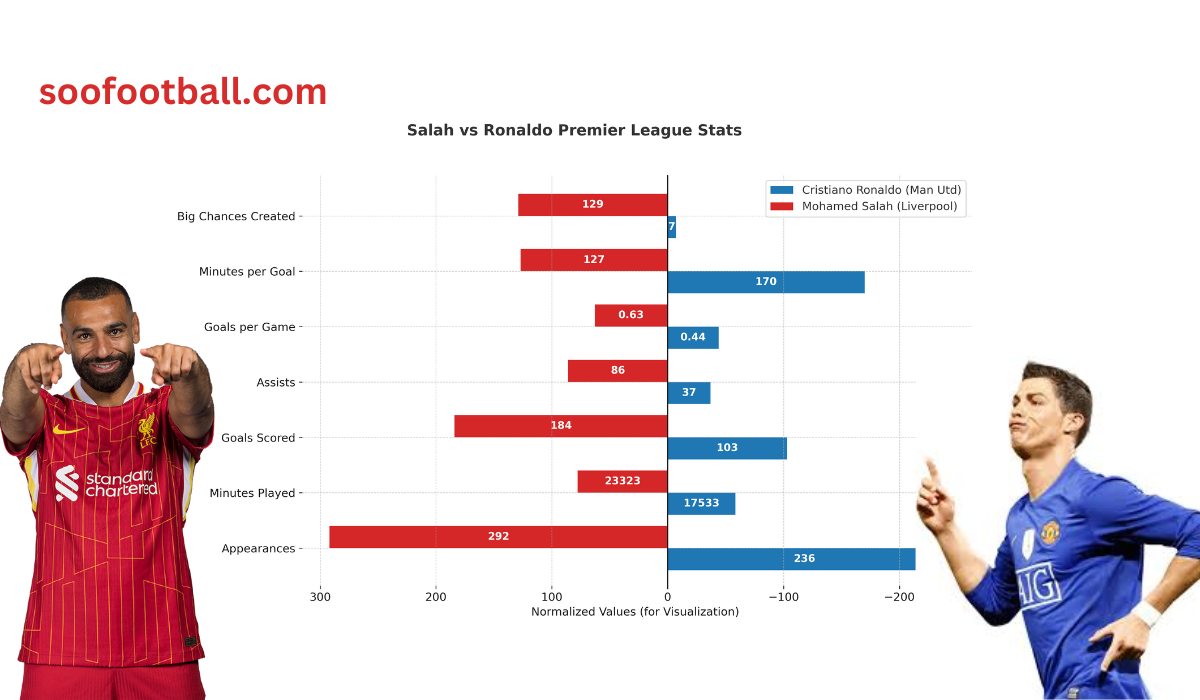
    Our analysis revolves around several key metrics: the number of appearances, goals scored, assists provided, total minutes played, goals per game, minutes per goal, and overall goal involvement per 90 minutes. One metric that often sparks debate is “big chances created” — an indicator of a player’s creative contribution by generating high-quality goal-scoring opportunities. For context, official data shows that while Cristiano Ronaldo created 7 big chances during his Manchester United era, Mohamed Salah has created a staggering 129 big chances for Liverpool in the Premier League.

    Salah vs Ronaldo Premier League Stats Analysis

    When we look at the raw numbers, the differences become immediately apparent. Cristiano Ronaldo made 236 Premier League appearances for Manchester United, accumulating 17,533 minutes on the pitch. During that period, he scored 103 goals and registered 37 assists, averaging roughly 0.44 goals per game. In comparison, Mohamed Salah’s record at Liverpool includes 292 appearances and 23,323 minutes played. Salah’s numbers shine further with 184 goals and 86 assists, equating to an average of 0.63 goals per game. This means that Salah finds the net more frequently and also contributes more to his team’s overall attacking output.

    A useful way to visualize these differences is by considering the number of minutes each player requires to score a goal. Ronaldo averaged about one goal every 170 minutes, while Salah’s efficiency stands at approximately one goal every 127 minutes. When combined with their assist records, Salah’s overall goal involvement per 90 minutes is significantly higher than Ronaldo’s in the Premier League. This stark contrast forms the backbone of our analysis.

    To summarize these comparisons, consider the following table:

    Metric Cristiano Ronaldo (Man Utd) Mohamed Salah (Liverpool)
    Appearances 236 292
    Minutes Played 17,533 23,323
    Goals Scored 103 184
    Assists 37 86
    Goals per Game 0.44 0.63
    Minutes per Goal ~170 ~127
    Big Chances Created 7 129

    These numbers do more than simply display raw statistics; they tell a story of differing roles and contributions in the Premier League. While Ronaldo was known for his direct, clinical finishing at Manchester United, Salah’s game at Liverpool has been defined not only by his prolific scoring but also by his creative prowess. Salah’s high number of big chances created illustrates his integral role in building attacks and creating opportunities for his teammates—a dimension that Ronaldo’s Premier League numbers do not capture nearly as well.

    Salah vs Ronaldo Premier League Stats infographic

    Critical Evaluation – Questions Asked

    This analysis naturally raises several thought-provoking questions. If some argue that Ronaldo’s overall career achievements are unparalleled, how do they address the fact that, when compared solely on Premier League records, Salah’s numbers suggest a higher scoring frequency and more creative output? Is it fair to compare a player’s global legacy with league-specific performance, or should we recognize that the Premier League represents a unique environment that highlights different strengths?

    Another important consideration is the context in which these numbers were generated. The roles played by each star were shaped by the tactical systems at their respective clubs. Manchester United’s style during Ronaldo’s tenure might have limited his opportunity to create big chances, whereas Liverpool’s attacking philosophy has allowed Salah to flourish both as a scorer and a creator. Thus, one might ask: to what extent does a player’s environment influence these metrics? And if a player’s role is tailored to maximize their strengths, does that not deserve recognition in a fair comparison?

    Lastly, these statistics prompt us to ponder the relationship between volume and impact. While Ronaldo’s lower big chance creation figure might seem underwhelming compared to Salah’s, his overall record—including pivotal goals in high-pressure situations—remains impressive. Yet, when evaluating pure Premier League performance, Salah’s numbers provide a compelling case for his remarkable influence on the game.

    Logic Over Emotion

    One of the common arguments from Ronaldo fans is that his overall career accomplishments and his ability to change the outcome of a match in critical moments should overshadow the raw numbers. However, by narrowing our lens to Premier League stats, the debate shifts. In this context, the data suggests that Salah has not only been more efficient in scoring but also more consistent in his creative contributions.

    For instance, consider the discrepancy in big chances created: while Ronaldo’s 7 big chances may be viewed as a byproduct of his finishing-focused role, Salah’s 129 big chances underscore his dual-threat capability. The numbers force us to ask, how can one reconcile a player who excels in finishing with another who consistently builds attacking opportunities? And if we consider minutes per goal and overall involvement, Salah’s higher figures challenge any claim that Ronaldo’s record at Manchester United was the gold standard in the Premier League.

    Moreover, the context of their appearances must be considered. Salah’s role at Liverpool involves more touches and creative freedom in a system designed to maximize his output, while Ronaldo’s contribution, although significant, was more limited in a different tactical setup. Does this mean one player is inherently better, or that their contributions are uniquely suited to their teams? The numbers suggest that, at least in the Premier League, Salah’s overall impact on his team’s attacking play has been more substantial.

    Conclusion

    Ultimately, this comparison of Salah vs Ronaldo Premier League Stats invites readers to reflect on what truly defines excellence in one of the world’s toughest leagues. The figures reveal that Mohamed Salah, with his higher goals per game, superior scoring efficiency, and outstanding creative contributions—particularly the big chances created—has left an indelible mark on the Premier League. Meanwhile, Cristiano Ronaldo’s achievements at Manchester United remain impressive in their own right but, when viewed through the narrow lens of league-specific statistics, present a very different narrative.

    By asking the right questions—about context, role, and the nature of impact—this analysis encourages a balanced discussion that goes beyond overall career accolades. In the end, the numbers provide a logical framework for comparison that challenges us to appreciate the unique contributions of both players while recognizing that, in the Premier League, Mohamed Salah’s record stands out as exceptionally prolific and creatively influential.

    The debate may never be conclusively resolved, but by focusing solely on Premier League data, we offer a fresh perspective on two of football’s modern icons. Whether you lean toward Ronaldo’s legendary status or appreciate Salah’s record-breaking output, the truth remains that both have shaped the league in remarkable ways—each in their own distinct manner.

    [ad_2]

    Source link