Typical really. Rather than blogging right after one of our recent high points – the first away win at our neighbours in nine years, or the Platt-like last-minute winner against Utd – I’ve picked up my pen after our second league defeat of the season. A genius move. Rough with the smooth and all that.
To say I’d had a premonition about this would be a tall story: to be fair, my default position before most games is ‘potential banana skin: treat with ultimate caution’. But in hindsight it had all the ingredients for a slip-up, and slip up we did.
I suppose the worst thing you can say is that had you parachuted in from another realm, you wouldn’t necessarily have known which side was top. Which given there are 16 places between us is telling.
Everton played with – to quote Ian King in Football365 – “a shot of Vitamin Dyche” and we, while not quite lacklustre, lacked a bit of lustre. Ben White and Thomas Partey’s passing was off-whack, and most of our players seemed to be wearing sand-wedges rather than boots. The amount of ballooned shots was almost comical. When we aren’t on our game, doubling up on our wide men (as Newcastle did) is very effective.
It is a bit disconcerting, because – credit to Everton aside – our levels have rarely dropped this low, not this season. Leeds away is the nearest we came to that performance, and this time we didn’t have it in us to get close to nicking a win.
A dose of smelling salts too, for Arsenal, I hope. The second half of this season was always going to be harder than the first. Partly because people have sat up and noticed us, which makes us even bigger scalps than normal. Partly also because the pressure is only going to ramp up from here. You felt ill with worry yesterday? It’s only just begun and for all the admirable sang-froid this team has shown to date, most of them won’t have experienced this before.
It’s going to be fun, but it’s going to be very hard.
As an aside, I never forget how lucky I am to have started following Arsenal when I did, from the George Graham years through to early Wenger years. It’s easy to forget that most people under 25 have no recollection of us being in a position like this. They are willing it along (my 17-year old is convinced if we beat City we will go on and do it – I’m trying to inject some realism but maybe that makes me a killjoy), but they have very little to compare it to.
By that age I’d seen us win the league three times, and come close a few more times than that.
If you’ve not experienced this before, you will soon learn what it feels like to edge through spring like this. It could go either way. It might send you to heaven, but it might break your soul.
The Bundesliga, Germany’s top-flight football league, has gained immense popularity among soccer fans in the United States. With its fast-paced gameplay, world-class players, and passionate supporters, it has become one of the most-watched European leagues globally. However, for many American fans, finding the right way to watch Bundesliga matches can be a challenge due to various broadcasting rights and streaming platforms.
Understanding how to watch Bundesliga in USA is essential for both longtime followers and new fans who want to enjoy live matches, highlights, and exclusive content. Over the years, Bundesliga broadcasting rights in the U.S. have changed, leading to different streaming services and TV networks offering coverage. Whether you prefer traditional cable TV, live streaming, or on-demand replays, multiple options are available to ensure you never miss a game.
One of the primary reasons Bundesliga viewership has increased in the U.S. is the presence of American players in German clubs. Stars like Gio Reyna, Christian Pulisic (formerly at Borussia Dortmund), and Weston McKennie (formerly at Schalke 04) have created a strong connection between the Bundesliga and U.S. fans. This growing interest has prompted major streaming services and television networks to secure broadcasting deals, making it easier than ever to watch Bundesliga action from anywhere in the country.
In this guide, we’ll explore the best streaming services, TV channels, and devices that allow American viewers to access Bundesliga matches. By the end, you’ll have a clear understanding of the best ways to follow your favorite teams and enjoy the Bundesliga experience in the U.S.
Streaming Services Offering Bundesliga Matches
With the decline of traditional cable TV and the rise of digital platforms, streaming services have become the primary way for American soccer fans to watch Bundesliga matches. These platforms offer flexibility, allowing viewers to watch games live or on demand from any device. The advantage of streaming services is the variety of features they provide, including multi-view options, pause-and-rewind functionality, and access to exclusive content such as pre-game analysis and post-match interviews.
Several streaming services in the USA hold broadcasting rights for Bundesliga games, and choosing the best one depends on factors like pricing, additional features, and the need for a cable subscription. Many of these services offer free trials, allowing users to explore their content before committing to a monthly or annual subscription.
ESPN+ – The most affordable option, ESPN+ provides access to a large number of Bundesliga matches, highlights, and analysis. It does not require a cable subscription and offers exclusive content, including interviews with players and coaches.
FuboTV – A sports-focused streaming service that includes channels broadcasting Bundesliga matches. It offers cloud DVR, multiple screen viewing, and a variety of sports channels beyond soccer.
Sling TV – A budget-friendly service with customizable channel packages. Although it requires specific add-ons for Bundesliga coverage, it remains a flexible option for cord-cutters.
Hulu + Live TV – A hybrid service that combines live TV streaming with on-demand content. It includes major sports channels that broadcast Bundesliga games and offers an easy-to-navigate interface with DVR functionality.
Streaming services not only provide Bundesliga matches but also additional football-related programming, including match previews, tactical breakdowns, and behind-the-scenes coverage of teams. The availability of these services on multiple devices—smart TVs, gaming consoles, mobile phones, and tablets—ensures that fans can watch their favorite teams anytime and anywhere.
When choosing a streaming platform, it’s important to consider internet speed and device compatibility to ensure the best viewing experience. Some services offer HD and 4K streaming, but buffering issues can occur if the connection is unstable. Additionally, features such as multiple user accounts and simultaneous streaming allow households to watch Bundesliga matches without interruptions.
By selecting the right streaming service, Bundesliga fans in the USA can enjoy a seamless and immersive viewing experience, staying up-to-date with all the action from Germany’s top football league.
Television Channels Broadcasting Bundesliga
While streaming services have become the preferred method for watching sports, traditional television channels remain a reliable option for Bundesliga fans in the United States. Many sports networks continue to secure broadcasting rights, ensuring that viewers can enjoy live matches, pre-game analysis, and post-match discussions from the comfort of their homes.
In recent years, major sports broadcasters in the U.S. have competed for the rights to air Bundesliga games, leading to exclusive agreements with certain networks. This means that fans looking for Bundesliga coverage on cable or satellite TV need to check which channels currently hold the broadcasting rights.
Top TV Networks for Bundesliga Coverage
One of the leading broadcasters for Bundesliga matches in the U.S. is ESPN, which has held the exclusive English-language rights to the league in recent seasons. Most games are aired on ESPN, ESPN2, and ESPN Deportes (for Spanish-language commentary), while many are also available on ESPN+. The network provides extensive coverage, including expert commentary, player interviews, and tactical analysis.
In addition to ESPN, some Bundesliga matches may also be shown on networks like ABC, particularly high-profile games or season openers. Meanwhile, German-language channels such as Deutsche Welle (DW) offer news and Bundesliga highlights, catering to German-speaking audiences in the U.S.
Understanding how to watch Bundesliga in USA through traditional TV channels is essential for fans who prefer cable or satellite over streaming. With the right network subscription, viewers can access live broadcasts, match replays, and in-depth coverage, ensuring they never miss a moment of the action.
Device Compatibility and Viewing Options
With the increasing shift towards digital streaming, Bundesliga fans in the USA have multiple options for watching matches on various devices. Whether using a smart TV, mobile phone, or gaming console, viewers can access live games and on-demand content seamlessly. However, choosing the right device depends on factors like streaming quality, ease of access, and app compatibility.
Most streaming services that broadcast Bundesliga games support multiple platforms, allowing users to switch between devices based on convenience. For example, watching on a large-screen TV provides an immersive experience, while mobile devices allow fans to catch matches on the go. Some platforms even support multi-device viewing, making it easier for families or friends to watch games simultaneously from different locations.
Device Type
Compatible Services
Notable Features
Smart TVs
ESPN+, FuboTV, Hulu
HD/4K streaming, direct app access
Streaming Sticks
Roku, Amazon Fire Stick
Portable, plug-and-play, supports major apps
Gaming Consoles
PlayStation, Xbox
Integrated sports streaming apps
Mobile Devices
iOS, Android
On-the-go viewing, push notifications
Not all devices offer the same level of streaming performance. While smart TVs and gaming consoles typically support high-definition and 4K resolution, older models may experience buffering or lower-quality playback. Additionally, some streaming services impose restrictions on the number of devices that can be used at the same time, requiring users to upgrade their subscriptions for multiple logins.
For fans who travel frequently, mobile devices provide the most flexible option. Many streaming services offer offline viewing, allowing users to download matches and watch them without an internet connection. However, using a stable and high-speed connection is still essential for live streaming to avoid interruptions.
When selecting a device for Bundesliga viewing, it is important to consider both performance and user convenience. Features such as voice search, personalized recommendations, and cloud DVR storage can further enhance the experience, making it easier to keep up with the latest action from Germany’s top football league.
Tips for Enhancing Your Bundesliga Viewing Experience
Watching Bundesliga matches is more than just tuning in for 90 minutes—it’s about creating an immersive and enjoyable experience. Whether you’re watching at home or on the go, optimizing your setup can significantly improve the quality of your viewing. From internet speed to audio settings, several factors contribute to how engaging a match feels, especially when streaming live games.
The first and most important aspect to consider is internet speed and connection stability. Many streaming platforms require a minimum internet speed to provide high-definition (HD) or 4K-quality streams without buffering. A wired connection or a high-speed Wi-Fi router can reduce lag and provide uninterrupted coverage, ensuring that every moment of the game is crystal clear.
Optimizing Your Setup for the Best Experience
A high-quality viewing experience isn’t just about video clarity—it’s also about sound and ambiance. Investing in a sound system or high-quality headphones can replicate the energy of a stadium, bringing you closer to the action. Some streaming services even offer multiple audio options, allowing you to switch between English commentary, Spanish commentary, or even natural stadium sounds for a more immersive feel.
Another way to enhance your Bundesliga experience is by using second-screen engagement. Many fans follow real-time stats, live commentary, and social media discussions while watching the match. Platforms like Twitter and Bundesliga’s official app provide up-to-the-minute updates, player insights, and in-depth tactical breakdowns.
For those wondering how to watch Bundesliga in USA with the best experience, setting up match reminders and customizing notifications on streaming apps is helpful. This ensures you never miss a game and allows you to follow your favorite teams without constantly checking the schedule.
With the right setup, Bundesliga fans in the USA can enjoy an exciting and seamless viewing experience, bringing the passion of German football straight to their screens.
The Best Ways to Watch Bundesliga in the USA
The Bundesliga continues to captivate soccer fans worldwide, and for those in the United States, multiple options exist to enjoy every match live or on demand. Whether you prefer traditional cable TV, streaming services, or mobile viewing, the availability of Bundesliga coverage has never been better.
Over the years, broadcasting deals have evolved, making it essential for fans to stay informed about the best ways to access live games. With platforms like ESPN+, FuboTV, and Hulu + Live TV, viewers can choose between dedicated sports streaming services and comprehensive live TV packages that include Bundesliga coverage. Additionally, some matches are broadcast on major networks like ABC, allowing broader access for those without paid subscriptions.
Understanding how to watch Bundesliga in USA is crucial for fans who want to follow their favorite teams without interruptions. The key is selecting a platform that suits your viewing preferences, whether you prioritize affordability, high-definition streaming, or access to exclusive match analysis. For those who value flexibility, mobile apps and smart TV compatibility make it possible to watch Bundesliga matches anytime and anywhere.
As the league continues to expand its presence in the U.S., new broadcasting agreements and improved digital experiences will likely enhance accessibility even further. Fans can stay up to date by following official Bundesliga channels, checking with streaming providers for the latest offerings, and exploring additional features such as multi-screen viewing and match replays.
With the right setup, Bundesliga enthusiasts in the USA can enjoy an exciting and immersive viewing experience, keeping up with all the action from Germany’s top football league. No matter which team you support, securing the best streaming or TV option ensures you never miss a crucial match or unforgettable moment in the Bundesliga season.
Frequently Asked Questions
With Bundesliga’s growing popularity in the United States, many fans have questions about how to access matches, what streaming services to use, and other aspects of watching the league. Since broadcasting rights and viewing options change over time, it’s essential to stay updated on the best ways to follow the action.
In this section, we address some of the most common questions American viewers have about Bundesliga coverage. Whether you’re looking for live match access, replays, or subscription details, these answers will help clarify the most important aspects of watching Bundesliga in the U.S.
Do I need a cable subscription to watch Bundesliga games? No, many streaming platforms offer Bundesliga matches without requiring a traditional cable TV subscription. Services like ESPN+ and FuboTV provide standalone options.
Are Bundesliga matches available in languages other than English? Yes, several broadcasters offer matches with commentary in Spanish and German. ESPN Deportes provides Spanish-language coverage, while Deutsche Welle offers German-language highlights.
Can I watch Bundesliga matches for free? Some streaming services offer free trial periods, allowing new users to watch Bundesliga matches for a limited time. Additionally, select high-profile matches may be aired on ABC or other free-to-air networks.
Are match replays available if I miss a live game? Yes, many platforms provide on-demand replays. ESPN+ allows users to watch full matches and highlights after the live broadcast has ended.
What is the best streaming service for Bundesliga coverage? The best service depends on your preferences. ESPN+ is affordable and offers extensive coverage, while FuboTV and Hulu + Live TV provide access to multiple sports channels.
While these answers provide a general guide, it’s always best to check with official broadcasters and streaming services for the most up-to-date information on Bundesliga coverage. Subscription prices, available channels, and streaming features can change, so reviewing the latest details ensures you get the best experience.
Additionally, factors like internet speed, device compatibility, and multi-screen viewing can affect how smoothly you watch matches. Ensuring a stable internet connection and using a reliable streaming service can greatly enhance your Bundesliga viewing experience.
For fans who want an even deeper connection with the league, following official Bundesliga social media channels and using interactive apps can provide match updates, real-time statistics, and behind-the-scenes content. Staying informed helps fans make the most of their Bundesliga experience, whether they’re watching live games or catching up on highlights.
Liverpool striker Darwin Nunez is firmly on Atletico Madrid’s radar ahead of the summer transfer window. Following an underwhelming season at Anfield, the Uruguayan forward could be heading for a fresh start in La Liga.
Nunez Set for Exit After Mixed Campaign
According to Fichajes, Liverpool are open to selling Nunez and hope to recoup around €40–45 million. With just 14 goal contributions across all competitions this season, the Reds are ready to move on and invest in a more consistent goal threat.
The 24-year-old has struggled to cement a regular starting spot under Jurgen Klopp, often playing second fiddle to more clinical attackers. A switch to Spain — where many South American players feel more at home — could revitalise his career.
Simeone’s Project Could Unlock Nunez’s Potential
Atletico Madrid presents an enticing opportunity. Under Diego Simeone, Nunez could flourish in a system built on intensity and attacking transitions. The Argentine manager has a strong track record of getting the best out of his forwards — and Nunez’s physicality and flair could suit La Liga perfectly.
Liverpool Eyeing Fresh Firepower
Liverpool, meanwhile, must address their attacking inconsistency. Despite lifting the Premier League title this season, replacing Nunez with a reliable frontman is essential. Names like Alexander Isak have already been linked with a move to Anfield.
With ambitions to dominate again next season, the Reds will be active in the market — and Nunez’s departure may be the first domino to fall.
The Bundesliga is Germany’s top-tier football league, widely regarded as one of the most competitive and exciting leagues in the world. Featuring 18 teams, the league follows a 34-matchday format where each club plays home and away matches against every other team. Known for its high-scoring games, passionate fan culture, and strong youth development programs, the Bundesliga attracts millions of viewers globally.
A key aspect of the Bundesliga’s appeal is its structured schedule, which allows clubs to compete at their peak while balancing international commitments. The season typically runs from August to May, with a winter break in December and January. This break is unique compared to other European leagues, as it provides teams with much-needed rest and preparation time for the second half of the season.
For football fans, players, and club management, knowing when does Bundesliga start is essential. Fans plan trips to stadiums, broadcasters schedule match coverages, and clubs finalize their pre-season preparations accordingly. Additionally, international players need to coordinate their return from off-season tournaments, ensuring they are match-fit before the campaign begins.
Beyond the excitement of the opening match, the first few weeks of the Bundesliga season set the tone for title contenders and relegation battles. Teams that start strong can build early momentum, while those struggling may face an uphill battle for survival. Understanding the league’s structure and its start date helps supporters and analysts track key developments throughout the season.
Historical Start Dates of the Bundesliga
The Bundesliga has maintained a relatively consistent schedule over the years, with the season usually beginning in mid-to-late August. However, certain external factors, such as international tournaments or global disruptions, have occasionally led to variations in the league’s start date. By examining the historical start dates of recent Bundesliga seasons, we can identify patterns and trends that influence scheduling decisions.
One of the main reasons for slight fluctuations in the starting date is the coordination with UEFA competitions and international tournaments such as the FIFA World Cup and UEFA European Championship. In years when these events take place, the Bundesliga schedule may shift slightly to accommodate national team commitments and ensure adequate player rest.
Another major factor is the winter break, which has been a key part of German football culture. Unlike the English Premier League, which runs through December and January, the Bundesliga incorporates a pause that allows teams to reset and recover for the second half of the season. The league’s governing body, Deutsche Fußball Liga (DFL), adjusts the start date to ensure the season aligns with international standards while maintaining this traditional break.
2023-24 Season: August 18, 2023
2022-23 Season: August 5, 2022
2021-22 Season: August 13, 2021
2020-21 Season: September 18, 2020 (Delayed due to COVID-19)
2019-20 Season: August 16, 2019
The list above highlights how the Bundesliga generally begins in mid-August, except for the 2020-21 season, which was delayed due to the global pandemic. The 2022-23 season started earlier than usual to accommodate the 2022 FIFA World Cup in Qatar, which took place in November and December.
Looking at these historical patterns, it becomes evident that while the Bundesliga aims for consistency, external events can significantly impact scheduling. The league must balance club, international, and broadcast interests to ensure a fair and well-structured season for teams and fans alike.
Official Start Date for the Upcoming Season
The Bundesliga is one of the most anticipated football leagues globally, attracting millions of fans eager to witness top-tier German football. Every season, the league follows a structured calendar, ensuring that teams and supporters can plan accordingly. The Deutsche Fußball Liga (DFL), the governing body of the Bundesliga, announces the official start date well in advance to maintain consistency and coordination with domestic and international competitions.
For the upcoming season, the DFL has confirmed the official start date, ensuring that clubs have adequate time for pre-season preparations and transfers. The opening match, as per tradition, will feature the defending champions playing at home, setting the stage for another exciting season of German football.
Factors Affecting the Start Date
Several factors influence when the Bundesliga begins each year. One of the primary considerations is international tournaments, such as the FIFA World Cup or the UEFA European Championship, which can impact the scheduling of domestic leagues. In years when these tournaments take place, the Bundesliga may start earlier or later than usual to accommodate national team duties and allow players sufficient rest.
Another important aspect is the synchronization with other major European leagues and UEFA competitions. Aligning the schedule with the Champions League, Europa League, and Conference League is crucial to ensure fair competition and avoid fixture congestion. Additionally, broadcasters play a significant role in determining match dates, as TV rights agreements influence scheduling decisions to maximize viewership.
Understanding when does Bundesliga start is essential for clubs, players, and fans alike. It marks the beginning of months of thrilling football action, intense rivalries, and battles for the title, European qualification, and relegation survival. With the schedule now confirmed, excitement builds as supporters eagerly await the first whistle of the new campaign.
Key Dates and Fixtures of the Season
The Bundesliga season is structured around a carefully planned schedule that includes important matches, international breaks, and the winter pause. Fans and analysts closely monitor key fixtures, as they often determine the course of the league, influencing title races, European qualifications, and relegation battles.
The season opener is a highly anticipated event, traditionally featuring the reigning champions in a high-profile match. This fixture sets the stage for the months ahead, as teams compete for crucial points in pursuit of their respective objectives. Some of the most exciting games of the season include fierce rivalries such as Der Klassiker between Bayern Munich and Borussia Dortmund and regional derbies that ignite passion among fans.
Apart from domestic fixtures, Bundesliga clubs also participate in European tournaments such as the UEFA Champions League, Europa League, and Conference League. These additional commitments require careful scheduling to avoid fixture congestion and ensure players remain in top condition.
The winter break is another defining feature of the Bundesliga schedule. Unlike other top European leagues, the German league includes a mid-season pause, allowing players to recover and teams to reassess their strategies for the second half of the campaign. This break typically lasts from mid-December to early January.
Event
Date
Description
Season Opener
August 16, 2024
Reigning champions play the first match
First Major Derby
September 21, 2024
Borussia Dortmund vs. Schalke 04
Winter Break Start
December 20, 2024
Last round of fixtures before the break
Winter Break End
January 12, 2025
League resumes after the holiday period
Final Matchday
May 17, 2025
Last round of regular season matches
These dates serve as milestones throughout the season, helping fans, clubs, and broadcasters prepare for key moments. While match schedules are subject to minor adjustments due to unforeseen circumstances, the general structure remains stable, ensuring a well-balanced and competitive league campaign.
As teams gear up for another exciting Bundesliga season, supporters eagerly anticipate standout fixtures and thrilling encounters that will define the journey to the championship.
Factors Influencing the Season’s Schedule
The Bundesliga schedule is carefully structured each year to accommodate various factors that impact both domestic and international football. While the league follows a traditional format, several external elements influence when and how matches are arranged. From international tournaments to broadcasting rights and weather conditions, the season’s schedule is shaped by multiple considerations to ensure a fair and competitive playing field.
One of the most significant factors affecting the league calendar is the alignment with FIFA and UEFA tournaments. The FIFA World Cup, UEFA European Championship, and Nations League all play a role in determining when domestic leagues can start and pause. During seasons that follow major tournaments, players returning from national duties need sufficient rest before resuming club commitments.
Impact of Broadcasting and Fan Engagement
Television rights and broadcasting deals are another crucial factor influencing the schedule. With millions of fans watching worldwide, broadcasters negotiate prime-time slots to maximize viewership. These agreements ensure that matches are spread out throughout the weekend and midweek slots, allowing for optimal global reach while balancing player recovery periods.
Weather conditions also play a role, particularly in the winter months. Unlike leagues in southern Europe, where milder conditions allow for continuous play, the Bundesliga incorporates a winter break to prevent disruptions caused by harsh weather. This pause benefits both players and fans, ensuring that the quality of football remains high and stadium attendance is not affected by extreme cold.
Understanding when does Bundesliga start is crucial for teams preparing their squads and fans planning their attendance. With a well-balanced schedule that considers international duties, commercial interests, and player welfare, the Bundesliga maintains its reputation as one of the most efficiently organized football leagues in the world.
How Fans Can Stay Updated
The Bundesliga is one of the most watched football leagues in the world, attracting millions of fans eager to follow their favorite teams throughout the season. With an extensive match schedule, international competitions, and potential fixture changes, staying updated with the latest Bundesliga news is essential for fans. Whether planning to attend matches, watch broadcasts, or follow live updates, there are several reliable sources to ensure you never miss a moment of the action.
Modern technology has made it easier than ever to stay informed about fixtures, results, and player news. Fans can access real-time updates through official platforms, sports apps, and social media channels. Clubs and league officials frequently update their schedules, making it essential to follow credible sources for the most accurate information.
Official Bundesliga Website – The league’s official site provides the latest fixture updates, standings, and match results.
Club Websites and Social Media – Each Bundesliga club has an official website and social media pages with match previews, ticket details, and team news.
Sports Apps – Platforms like ESPN, OneFootball, and FotMob offer live scores, push notifications, and player statistics.
TV and Streaming Services – Networks such as Sky Sports, ESPN, and DAZN broadcast Bundesliga matches live with expert analysis.
Football Forums and News Outlets – Reputable sports media outlets like BBC Sport, Kicker, and Bundesliga.com provide in-depth match reports and analysis.
By using these sources, fans can ensure they stay informed about team lineups, game schedules, and unexpected fixture changes.
Apart from digital platforms, traditional methods such as matchday programs and sports newspapers still serve as valuable sources of information for those who prefer print media. Additionally, engaging with fan communities, online forums, and local supporters’ clubs can enhance the experience of following the Bundesliga.
For those attending games in person, checking club announcements regarding ticket sales and stadium regulations is crucial. Many teams provide email notifications for registered supporters, ensuring fans receive direct updates about upcoming matches, travel arrangements, and seating availability.
With so many ways to stay updated, following the Bundesliga has never been easier. Whether through mobile apps, social media, or live broadcasts, fans have access to real-time information that enhances their football experience.
The Importance of Knowing When the Bundesliga Starts
The start of a new Bundesliga season is an exciting time for football fans, players, and clubs alike. Every year, supporters eagerly anticipate the opening match, marking the beginning of months of intense competition, thrilling moments, and unexpected surprises. The league’s structured schedule ensures that teams are well-prepared, while fans can plan their match viewings, stadium visits, and fantasy football strategies accordingly.
Understanding when does Bundesliga start is essential for anyone following German football. The season’s timeline affects not only domestic competitions but also international club and national team fixtures. For clubs, preseason planning, transfers, and fitness preparations are all aligned with the league’s official start date. Players returning from international duty must adjust to club schedules, ensuring they are in peak condition when the first whistle blows.
For fans, knowing the Bundesliga’s start date allows for better preparation, whether it’s purchasing season tickets, setting reminders for key fixtures, or planning trips to see their favorite teams in action. International supporters who follow the league closely also need to adjust their schedules to accommodate live broadcasts, which vary depending on global time zones.
Additionally, with an increasing number of broadcasting platforms and streaming services offering live coverage of Bundesliga matches, having a clear understanding of the league’s schedule helps fans stay engaged throughout the season. Whether watching from home, at a sports bar, or in the stadium, every game is an opportunity to experience the passion and energy that make German football unique.
As the new season approaches, excitement continues to build, and the countdown to kickoff begins. Fans across the world are preparing for another unforgettable Bundesliga campaign, filled with unforgettable moments, heated rivalries, and championship battles.
The Bundesliga is Germany’s top-tier professional football league, recognized worldwide for its competitive nature and passionate fan base. Established in 1963, the league has become one of the most prestigious in Europe, producing legendary players, world-class clubs, and thrilling football experiences. Unlike many other European leagues, the Bundesliga is known for its strong emphasis on homegrown talent, financial sustainability, and fan-friendly policies.
Before the Bundesliga’s formation, German football was fragmented into various regional leagues, lacking a unified system. The introduction of a nationwide league helped streamline professional football in Germany, allowing clubs to compete at a higher level and ensuring better organization. Since then, the Bundesliga has undergone numerous transformations, including structural changes, increased commercial appeal, and advancements in player development programs.
A key characteristic of the Bundesliga is its remarkable attendance figures. It consistently boasts one of the highest average attendance rates in global football, surpassing leagues like the English Premier League and La Liga. This is largely due to its affordable ticket prices and a culture that prioritizes fan involvement. The iconic 50+1 rule, which prevents private investors from owning a controlling stake in clubs, ensures that supporters maintain significant influence over their teams.
Another defining aspect of the Bundesliga is its fast-paced, high-scoring matches. Compared to other top European leagues, Bundesliga games tend to feature more goals per match on average, making it an attractive spectacle for fans. Clubs like Bayern Munich, Borussia Dortmund, and RB Leipzig have played significant roles in shaping the league’s identity, competing in both domestic and international tournaments.
Understanding what is Bundesliga is crucial for any football enthusiast looking to explore the dynamics of European football. It is a league built on history, tradition, and a commitment to excellence. Whether through its top-class football, passionate supporters, or impressive youth development programs, the Bundesliga remains a cornerstone of the global football landscape.
Structure and Format of the Bundesliga
The Bundesliga operates under a unique league format that distinguishes it from other major European football competitions. Unlike leagues such as the English Premier League or Serie A, which have 20 teams, the Bundesliga consists of 18 teams. This structure results in a slightly shorter season, with each club playing 34 matches—17 at home and 17 away.
One of the key features of the Bundesliga is its promotion and relegation system, which connects it to the 2. Bundesliga, the second division of German football. At the end of each season, the bottom two teams in the Bundesliga are automatically relegated to the second tier, while the top two teams from the 2. Bundesliga are promoted. The 16th-placed Bundesliga team then plays a two-legged relegation playoff against the third-placed team from the 2. Bundesliga to determine which club will compete in the top division the following season.
3 points for a win
1 point for a draw
0 points for a loss
If two or more teams finish the season with the same number of points, the league uses several tie-breaking criteria to determine rankings. The first tiebreaker is goal difference, followed by total goals scored. If teams are still tied, head-to-head results between the clubs are considered.
Bayern Munich
Borussia Dortmund
RB Leipzig
Bayer Leverkusen
Eintracht Frankfurt
SC Freiburg
VfL Wolfsburg
Union Berlin
Borussia Mönchengladbach
Werder Bremen
VfB Stuttgart
TSG Hoffenheim
FC Augsburg
FSV Mainz 05
VfL Bochum
FC Heidenheim
Darmstadt 98
While the list of teams may change from season to season due to the promotion and relegation system, certain clubs like Bayern Munich and Borussia Dortmund have consistently remained in the top flight, shaping the league’s competitive landscape.
The league schedule runs from August to May, with a winter break in December and January, a tradition that accommodates Germany’s colder climate. Unlike some leagues, the Bundesliga also has a balanced fixture calendar, ensuring that each team faces every opponent twice in a fair and organized manner.
This structured format, combined with financial regulations and youth development programs, makes the Bundesliga one of the most sustainable and well-managed leagues in world football.
Historical Evolution of the Bundesliga
The Bundesliga has undergone significant changes since its establishment in 1963, evolving into one of the most respected football leagues in the world. Initially, German football was divided into multiple regional leagues known as the Oberliga, with no centralized national competition. The need for a unified, professional league became evident when Germany failed to compete effectively on the international stage in the 1950s.
After the German Football Association (DFB) approved the formation of a national league, the Bundesliga was launched with 16 teams, a number that later expanded to 18. The league’s early years were dominated by clubs like 1. FC Köln and Borussia Mönchengladbach, but it wasn’t long before Bayern Munich emerged as the most dominant force.
Major Transformations Over the Decades
One of the most significant moments in Bundesliga history was the reunification of Germany in 1990. This allowed clubs from East Germany to participate in the league structure, integrating teams that had previously competed in the separate DDR-Oberliga. This shift increased the league’s competitiveness and broadened its national appeal.
The 1990s and early 2000s saw increased commercialization and global reach, with the Bundesliga negotiating lucrative broadcasting deals. The introduction of modern stadiums before the 2006 FIFA World Cup in Germany also helped the league attract more international attention.
Today, understanding what is Bundesliga requires looking at its legacy as a league that balances financial stability with high-level competition. With strict financial regulations, an emphasis on youth development, and a tradition of exciting, attacking football, the Bundesliga continues to set itself apart as one of the world’s premier football leagues.
Bundesliga’s Impact on German Football
The Bundesliga has played a crucial role in shaping German football, both at the club and international levels. It is not just a competition; it serves as a platform for talent development, financial sustainability, and strategic football innovation. The league’s commitment to youth development and tactical evolution has made Germany one of the most successful football nations in history.
One of the biggest contributions of the Bundesliga is its youth academy system. Clubs invest heavily in their academies, focusing on technical and tactical training from a young age. The introduction of strict youth development regulations in the early 2000s has resulted in a steady pipeline of world-class players. This system produced stars such as Thomas Müller, Joshua Kimmich, and Jamal Musiala, who have become key figures for both their clubs and the national team.
Additionally, the Bundesliga’s financial model has been widely praised for its sustainability. Unlike other major European leagues, German clubs follow the 50+1 ownership rule, which ensures that fans retain majority control over club decisions. This prevents reckless spending and financial mismanagement, making the Bundesliga one of the most stable leagues in global football.
The league has also had a significant impact on Germany’s international success. Many key players in the German national team play in the Bundesliga, providing a strong domestic core that has led to victories in major tournaments, including the 2014 FIFA World Cup.
Year
Number of Bundesliga Players in Squad
Major Tournament Played
2010
19 out of 23
FIFA World Cup (3rd Place)
2014
16 out of 23
FIFA World Cup (Winners)
2018
15 out of 23
FIFA World Cup (Group Stage)
2022
17 out of 26
FIFA World Cup (Group Stage)
The table above shows the influence of the Bundesliga on the German national team. Despite fluctuating performances in recent tournaments, Bundesliga-based players remain the backbone of the squad.
Beyond player development, the league has also influenced tactical approaches in world football. The high-pressing style used by clubs such as RB Leipzig and Bayern Munich has been adopted by teams across Europe. Coaches trained in the Bundesliga, including Jürgen Klopp and Thomas Tuchel, have brought German tactical ideas to leagues like the Premier League and La Liga.
As a result, the Bundesliga continues to be a vital component of German football’s success. Through its commitment to sustainable growth, player development, and tactical evolution, the league will likely remain at the forefront of European football for years to come.
International Influence and Broadcast Reach
Over the years, the Bundesliga has expanded its influence beyond Germany, establishing itself as one of the most-watched football leagues in the world. While traditionally dominated by German fans, the league has successfully reached a global audience through strategic broadcasting deals, international partnerships, and marketing campaigns. Today, millions of viewers across different continents tune in to watch Bundesliga matches every week, making it a truly international football competition.
A key factor in this expansion is the league’s commitment to accessibility. The Bundesliga International division has actively worked to secure broadcasting deals in over 200 countries, ensuring that fans from Asia, North America, and Africa can watch live matches. The league has also tailored its scheduling to accommodate international time zones, helping to increase viewership in growing markets such as China, India, and the United States.
The Role of Global Stars in Popularizing the Bundesliga
One of the driving forces behind the Bundesliga’s global appeal is the presence of international football stars. Players from different regions bring their own fan bases, helping to increase viewership and media coverage. Over the years, world-class players like Robert Lewandowski, Erling Haaland, and Jadon Sancho have made the league more attractive to international fans. Additionally, the Bundesliga has become a stepping stone for emerging talents who later move on to other top European leagues.
Understanding what is Bundesliga also involves recognizing how its clubs engage with fans worldwide. Teams like Bayern Munich and Borussia Dortmund frequently organize international tours, participate in friendly matches abroad, and run social media campaigns in multiple languages. These initiatives help strengthen the Bundesliga’s global presence and ensure that it remains a key player in international football.
Bundesliga’s Unique Fan Culture and Matchday Experience
One of the defining characteristics of the Bundesliga is its vibrant fan culture and unmatched matchday atmosphere. Unlike other top European leagues, where corporate influence has steadily increased, German football remains deeply rooted in traditions that prioritize fan engagement and accessibility.
Bundesliga clubs have some of the highest average attendance rates in the world, with stadiums regularly filled to capacity. The affordability of tickets is a major reason for this. While leagues like the Premier League have faced criticism for rising ticket prices, the Bundesliga ensures that football remains accessible to all fans. The 50+1 rule, which prevents external investors from taking full control of clubs, helps maintain this supporter-first mentality.
Another key feature of Bundesliga matchdays is the incredible fan displays in stadiums. Clubs like Borussia Dortmund are famous for their Yellow Wall, a sea of passionate supporters who create a breathtaking visual spectacle. Choreographed tifo displays, coordinated chants, and colorful banners are all part of what makes Bundesliga matches a unique experience.
Affordable Ticket Prices – Compared to other top European leagues, Bundesliga tickets are significantly cheaper.
Standing Terraces – Unlike most leagues that have eliminated standing areas, Bundesliga stadiums still feature safe-standing terraces, allowing for a more dynamic atmosphere.
Strong Club-Fan Relationships – The 50+1 rule ensures that clubs prioritize their supporters’ interests over profit-driven motives.
Impressive Choreography and Chants – Fans organize large-scale tifo displays, which contribute to the electric stadium environment.
Local Identity and Loyalty – Unlike in some leagues where club ownership frequently changes, Bundesliga teams have maintained strong regional ties, fostering deeper community connections.
Despite the increasing commercialization of modern football, Bundesliga clubs have found a way to balance financial success with fan engagement. The atmosphere inside German stadiums remains unmatched, with clubs ensuring that their supporters continue to be at the heart of the game.
Additionally, the presence of family-friendly policies in Bundesliga stadiums has helped attract a broader demographic of fans, including younger audiences. Many clubs actively promote youth involvement by offering discounted tickets and organizing interactive events on matchdays.
Ultimately, the Bundesliga’s approach to fan culture has set a benchmark for leagues worldwide. The combination of affordable prices, standing terraces, and deeply rooted traditions ensures that matchdays remain an unforgettable experience for every supporter who walks through the stadium gates.
The Legacy and Future of The Bundesliga
The Bundesliga has firmly established itself as one of the most exciting and well-structured football leagues in the world. With a strong foundation built on financial sustainability, youth development, and fan engagement, the league continues to thrive both domestically and internationally. Its unique approach to club ownership and governance ensures that teams remain closely connected to their supporters, preserving the integrity of German football.
Throughout its history, the Bundesliga has adapted to various changes in global football while staying true to its core values. The league has been home to some of the greatest footballers and managers, influencing tactical developments and shaping the future of the sport. The presence of legendary clubs such as Bayern Munich, Borussia Dortmund, and RB Leipzig has contributed to its competitive nature, making every season an exciting spectacle for fans.
Despite its many successes, the Bundesliga faces challenges in maintaining its position among Europe’s elite leagues. The financial power of the Premier League and the global appeal of La Liga have led to increased competition for top talent. However, Bundesliga clubs have consistently found ways to remain competitive by developing young players and implementing innovative coaching methods.
Understanding what is Bundesliga means recognizing it as more than just a football league—it is a cultural phenomenon that represents the passion and dedication of German football. As the league looks to the future, its commitment to sustainability, competitive balance, and fan engagement will ensure that it remains a powerhouse in world football for years to come.
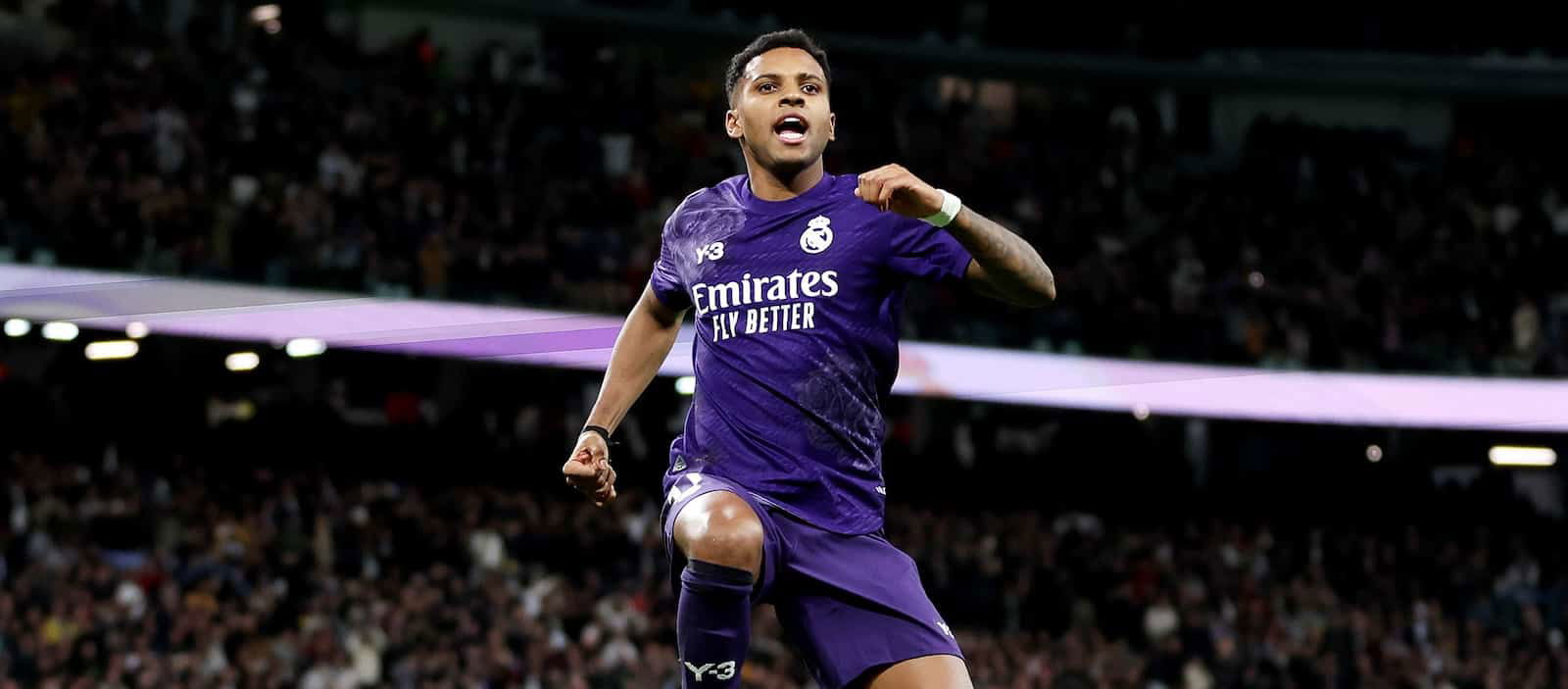
Manchester United are reportedly “leading the race” to sign Rodrygo as the Real Madrid winger draws closer to a dramatic exit from the Bernabeu.
Rodrygo, 24, was a crucial part of the Madrid side which secured an imperious Liga and Champions League double last season.
The Brazilian international scored 18 goals and provided nine assists in all competitions during the campaign, but it was his unrelenting work-rate and selflessness which made the skilful winger stand out.
The signing of French superstar Kylian Mbappe on a free transfer from Paris Saint-Germain in the summer has unsettled the balance of the Madrid attack this season, however.
Carlo Ancelotti has struggled to find a formula which fits Mbappe and Rodrygo into a functioning attack alongside Jude Bellingham and Vinicius Junior. Rodrygo has often been the victim of this imbalanced ‘quadro’ with less goals, assists and minutes on the pitch this season than last.
As a result, Madrid crashed out of the Champions League in the quarter-final stage against Arsenal and are currently second in La Liga, four points off leaders Barcelona.
Los Blancos’ bitter rivals also triumphed in the Copa del Rey final last weekend, beating Madrid 3-2, in what proved to be the final straw for Ancelotti’s time in the Spanish capital as it was confirmed the Italian coach would be leaving at the end of the season.
However, it now appears Rodrygo could be set to follow his manager through the exit door at the Bernabeu if a “big-money bid lands from the Premier League,” The Sun relays – with Old Trafford suggested as the most likely destination for the 24-year-old this summer.
“The 20-time Brazil international is ready to pack his bags and seek a new challenge, according to reports in the Spanish media.
“Real are believed to be looking for around £85million to let the Brazilian leave. Arsenal have been linked with a move, but it’s Manchester United who are reportedly leading the chase as they search for a statement signing for next season.”
The exorbitant transfer fee would prove difficult for the Red Devils to meet given the club’s financial difficulties, owing to the acute pressure of PSR.
But success in the Europa League this season – with a semi-final clash against Athletic Club this week – could offer both the prospect of Champions League football and a huge cash injection for United to use as negotiating gambits with Rodrygo’s representatives.
This remains a report The Peoples Person are sceptical of, given the unlikely idea Rodrygo would choose a side currently languished in 14th in the Premier League as his next destination, but if INEOS could pull off a sensational swoop it would arm Amorim with one of Europe’s elite attacking prospects to radically improving his misfiring forward line.
If there’s ever a good time to be out of work, it’s probably now.
With the Euros, the Olympics and Wimbledon all locked and loaded, rather than networking, putting out feelers and seeking new employment I can sit on my arse and watch sport until the cows come home. I’ve not relayed my plan to my wife yet, but I feel fully confident she will agree.
It is but a minor hurdle that I know very little about any of the teams or their players unless they play for Arsenal or are big names in the Premier League. In fact that makes it better, I think. My ignorance and lack of curiosity lend a certain exoticism to the whole thing that more earnest students of world football might not possess.
(I digress, but I remember my mum and dad had a book on the shelf in the loo when I was young called something like ‘What men know about women’ and there was not a word of print on any of the 250 pages. I feel this way a bit about Euro 2024.)
And there’s nothing better than the early stages of a big football tournament when there are three games a day on the telly. Especially when you don’t need to pretend you’re working. It doesn’t matter what they are, not one bit. If it’s on at 2, I’m in at 2. That’s my new mantra.
Everyone says England have a great chance, and maybe they do, but I’m not falling for that – it sounds disturbingly like optimism. Lord no. Disappointment is England’s middle name, and underachievement its sobriquet. I will approach with caution.
Plus, have you seen the French lads? They are so achingly hip. We cannot compete with this.
Just bring it all on. I cannot wait for the wall-to-wall football and to bond more firmly with my television. These relationships need nurturing, and nurture them I shall.
The Bundesliga is one of the most prestigious and competitive football leagues in the world, attracting millions of fans from Germany and beyond. Known for its high-intensity matches, passionate supporters, and a rich history of legendary clubs, the league plays a crucial role in the global football landscape. Each season, teams compete for the coveted Meisterschale (championship trophy), while others fight to avoid relegation or secure European competition spots.
A common question among football fans is: when does the Bundesliga season end? Understanding the timeline of the Bundesliga season is essential for supporters, players, and stakeholders. The league operates on a structured schedule that aligns with the European football calendar, typically starting in late summer and concluding in the following spring. However, several factors, including international tournaments and winter breaks, can influence the exact dates.
Unlike some other top European leagues, the Bundesliga consists of 18 teams rather than 20, resulting in a slightly shorter season. This format means that each club plays 34 matches (home and away fixtures against every opponent), making every game critical in determining final standings. The season is divided into two halves, separated by a winter break, which is a unique feature of German football. This pause allows players to recover and clubs to adjust strategies before the decisive second half of the campaign.
As we delve into the specifics of the Bundesliga season, including key dates, historical trends, and external factors that affect its conclusion, it becomes evident why fans eagerly anticipate the season finale. The final matchday often brings thrilling title races, dramatic relegation battles, and unforgettable football moments, making it a highly anticipated event in the sporting calendar.
Key Dates for the 2024/25 Bundesliga Season
The Bundesliga season follows a well-structured calendar, beginning in late summer and concluding in spring. The league’s scheduling is carefully planned to align with international competitions and domestic cup fixtures, ensuring a balanced and competitive format. Each season, the league’s governing body, the Deutsche Fußball Liga (DFL), announces the official start and end dates, allowing clubs and fans to prepare accordingly.
For the 2024/25 season, the Bundesliga will kick off on August 23, 2024, marking the beginning of another intense competition among Germany’s top clubs. The league’s format consists of 34 matchdays, spread across a span of approximately nine months, before reaching its conclusion in May 2025. While the final matchday is scheduled for May 17, 2025, external factors such as fixture rescheduling or European club competitions may slightly alter the timeline.
Additionally, the Bundesliga incorporates a mid-season winter break, which is a distinct characteristic compared to other major European leagues. This break provides players with essential rest and recovery time, allowing teams to prepare for the second half of the campaign.
Season Start: August 23, 2024
Winter Break Start: December 22, 2024
Winter Break End (Season Resumes): January 12, 2025
Final Matchday: May 17, 2025
DFB-Pokal Final: May 24, 2025
Relegation Playoffs: May 22 & 27, 2025
The winter break, which typically lasts around three weeks, is an essential feature of the Bundesliga. Unlike leagues such as the Premier League, which continues through the holiday season, the Bundesliga allows players to rest and recharge before heading into the decisive part of the season.
Moreover, the relegation playoffs, played between the third-bottom Bundesliga club and the third-placed 2. Bundesliga team, determine which team secures a spot in the top division for the following season. These matches add to the league’s excitement, often producing dramatic results.
As the season progresses, clubs focus on securing their objectives, whether it’s fighting for the title, European qualification, or top-flight survival. The final matchday is particularly significant, as it often decides the champion, the relegated teams, and the clubs earning a spot in Champions League and Europa League competitions.
The Impact of the Winter Break on the Season’s Schedule
The Bundesliga is unique among Europe’s top leagues due to its extended winter break, which plays a crucial role in shaping the second half of the season. While many leagues continue playing through December and January, German football authorities prioritize player welfare and match quality by implementing a mid-season pause. This break allows teams to rest, recover, and strategize for the remaining fixtures, often influencing the outcome of the league standings.
Why the Winter Break Matters
The winter break is more than just a pause in play—it impacts the rhythm of the competition and provides struggling teams with an opportunity to reset. Managers use this period to evaluate their squads, make tactical adjustments, and sometimes introduce new signings from the January transfer window. Additionally, the break benefits players physically, reducing the risk of injuries caused by fixture congestion.
Historically, teams that enter the break in strong form often continue their momentum, while those in poor form have the chance to regroup. Clubs also take advantage of the break to organize mid-season training camps, usually in warmer climates, to maintain fitness levels and refine tactical plans.
The scheduling of the Bundesliga ensures that every club has an equal opportunity to benefit from this period. However, the break also means that the season extends into May, leading many fans to ask, when does the Bundesliga season end – as they anticipate the final matchdays.
As the league resumes in January, teams face a packed schedule with high-stakes fixtures that determine final placements. The winter break, therefore, serves as both a reset button and a strategic advantage, making it one of the most important aspects of German football’s structure.
Historical End Dates of Recent Bundesliga Seasons
The Bundesliga has followed a consistent seasonal structure for decades, typically concluding in mid-to-late May. However, various factors, such as international tournaments, global disruptions, and scheduling adjustments, have occasionally led to minor changes in the league’s end date. Reviewing historical season conclusions provides valuable insight into how the league maintains its competitive flow while adapting to external influences.
In most cases, the season lasts approximately nine months, starting in August and ending in May, with a mid-season winter break factored in. This format ensures alignment with other major European leagues and facilitates the smooth scheduling of UEFA Champions League, Europa League, and international competitions.
Season
Start Date
End Date
Champion
2023/24
August 18, 2023
May 18, 2024
Bayer Leverkusen
2022/23
August 5, 2022
May 27, 2023
Bayern Munich
2021/22
August 13, 2021
May 14, 2022
Bayern Munich
2020/21
September 18, 2020
May 22, 2021
Bayern Munich
2019/20
August 16, 2019
June 27, 2020
Bayern Munich
2018/19
August 24, 2018
May 18, 2019
Bayern Munich
The 2019/20 season was significantly impacted by the COVID-19 pandemic, leading to an extended break and a delayed conclusion in June instead of the usual May timeframe. Similarly, the 2020/21 season started later than usual, as the previous season’s delay affected the league’s scheduling.
Despite occasional disruptions, the Bundesliga has maintained a structured and predictable season format, ensuring competitive integrity. The winter break remains a crucial element, allowing players and clubs to prepare effectively for the second half of the campaign.
Looking at past seasons, it is evident that while the Bundesliga follows a standardized timeline, certain factors can still influence its conclusion. However, fans can generally expect the season to wrap up in May, barring exceptional circumstances.
Factors Influencing the Season’s Conclusion
The Bundesliga season is carefully planned to follow a consistent schedule, but several external factors can influence its actual conclusion. While the league traditionally ends in May, occasional adjustments may be required due to unforeseen circumstances. These factors can impact the fixture list, match rescheduling, and overall league progression, sometimes leading fans to ask, when does the Bundesliga season end?
Major Factors Affecting the Bundesliga’s End Date
One of the most significant factors is the international tournament calendar. In years when the UEFA European Championship or FIFA World Cup takes place, domestic leagues must align their schedules to ensure players have adequate rest and preparation time. This often results in a tighter league calendar, with midweek fixtures becoming more frequent to maintain the usual May conclusion.
Weather conditions can also impact the league’s end date. While Germany does not typically experience extreme disruptions, heavy snowfall during December and January can lead to match postponements. If multiple games are delayed, the league must find available dates for rescheduling, which can create fixture congestion later in the season.
European club competitions also play a role in scheduling flexibility. Teams competing in the Champions League or Europa League often require fixture adjustments, especially in the later rounds when matches become more demanding. The deeper a Bundesliga team progresses in Europe, the more likely they are to request slight changes to their domestic schedule.
In rare cases, unexpected global events—such as the COVID-19 pandemic—have led to league-wide postponements and rescheduling efforts. The 2019/20 season, for example, had to extend into late June, marking one of the few instances where the league’s standard timeline was altered significantly.
Ultimately, while the Bundesliga strives to maintain its traditional timeline, multiple factors can influence its exact end date. However, with careful planning and flexibility, the league ensures that disruptions remain minimal, preserving the integrity of the competition.
Preparing for the Season Finale: What Fans Should Know
As the Bundesliga season nears its conclusion, fans eagerly anticipate the final matchdays, which often bring high-stakes drama, title deciders, and relegation battles. Whether supporting a team in the championship race, European qualification fight, or relegation struggle, fans need to be well-prepared to enjoy the season finale to the fullest.
In addition to the on-field action, the closing stages of the Bundesliga also impact ticket availability, match scheduling, and club celebrations, making it crucial for supporters to stay informed about key developments.
Secure Tickets Early: Demand for tickets skyrockets as the season nears its end, especially for decisive fixtures. Fans should purchase tickets well in advance to avoid disappointment.
Follow the League Standings Closely: The final weeks of the season determine title winners, European qualifiers, and relegated teams, making every match critical. Checking the standings regularly helps fans stay updated on their club’s position.
Be Aware of Playoff Scenarios: The Bundesliga features relegation playoffs, where the 16th-placed team in the top division faces the third-placed team from the 2. Bundesliga. These matches can have major implications for the following season.
Stay Updated on Fixture Changes: TV broadcasting rights and European competition schedules can lead to last-minute changes in match timings. Fans should check official sources for confirmed dates and kickoff times.
Prepare for Club Celebrations: If a team wins the Bundesliga, major parades and celebrations are organized in their home city. Knowing when and where these events take place allows fans to participate in the festivities.
While the Bundesliga finale is an exciting time, it also comes with logistical challenges for fans. Popular venues experience an increase in ticket demand, accommodation bookings, and travel expenses, making early planning essential.
Additionally, emotions run high during the last few matchdays, as clubs fight for their goals. Whether it’s a dramatic title-clinching victory, a last-minute European qualification, or a heartbreaking relegation battle, the Bundesliga’s closing stages never fail to deliver excitement.
Understanding the league format, being aware of critical dates, and staying engaged with official updates can help fans fully experience the thrill of the Bundesliga’s final weeks. With proper preparation, they can ensure that they don’t miss out on some of the most memorable moments of the season.
What to Expect as the Bundesliga Season Ends
As the Bundesliga season draws to a close, fans, clubs, and players reflect on the journey while eagerly anticipating the final outcomes. The last matchdays bring intense battles for the championship, European qualification, and relegation survival, ensuring that excitement remains high until the very end. Whether it’s a dominant club securing another league title or an underdog team fighting to avoid relegation, the conclusion of the season is always filled with drama.
One of the most anticipated aspects of the final matchdays is the title race. In recent years, the Bundesliga has witnessed thrilling finishes, with clubs competing fiercely to lift the prestigious Meisterschale. Even when the champion is determined before the final game, the competition for Champions League and Europa League spots remains intense, often decided in the last minutes of the season.
For teams struggling at the bottom of the table, the stakes are just as high. Avoiding relegation is a priority for clubs looking to maintain their Bundesliga status, and the relegation playoff adds another layer of excitement. The battle for survival can often be as gripping as the race for the title, with unexpected results shaping the future of clubs.
Fans frequently ask, when does the Bundesliga season end, especially as teams approach the decisive final rounds. The 2024/25 season is set to conclude on May 17, 2025, marking the culmination of months of competition. As the league wraps up, supporters will celebrate their club’s success or begin looking ahead to the next campaign, knowing that German football never fails to deliver thrilling moments.
With the final whistle of the season, the focus shifts to transfer windows, managerial changes, and preparations for the next campaign, keeping Bundesliga enthusiasts engaged even after the matches have ended.
In international football, scoring goals at the highest level is a mark of true greatness. The list of all-time greatest international goal scorers is not just a collection of numbers; it represents consistency, longevity, and an incredible ability to perform under pressure. Using a data-driven approach, we analyze the elite goal scorers of international football based on the latest numbers.
Best International Goal Scorers By Goals Per Game Metric
While raw goal totals are impressive, a deeper look at the scoring efficiency of each player adds more context. A useful metric to analyze is the Goals Per Game (GPG) ratio, which measures how frequently each player scores.
To calculate this, we use the formula:
Goals Per Game = Total Goals/Total Matches Played
Based on international appearances, here’s how the top six goal scorers compare:
Player
Country
Goals
Caps
Goals Per Game (GPG)
Romelu Lukaku
Belgium
86
113
0.76
Ali Daei
Iran
108
149
0.72
Cristiano Ronaldo
Portugal
135
205
0.66
Sunil Chhetri
India
95
143
0.66
Mokhtar Dahari
Malaysia
89
142
0.63
Lionel Messi
Argentina
112
180
0.62
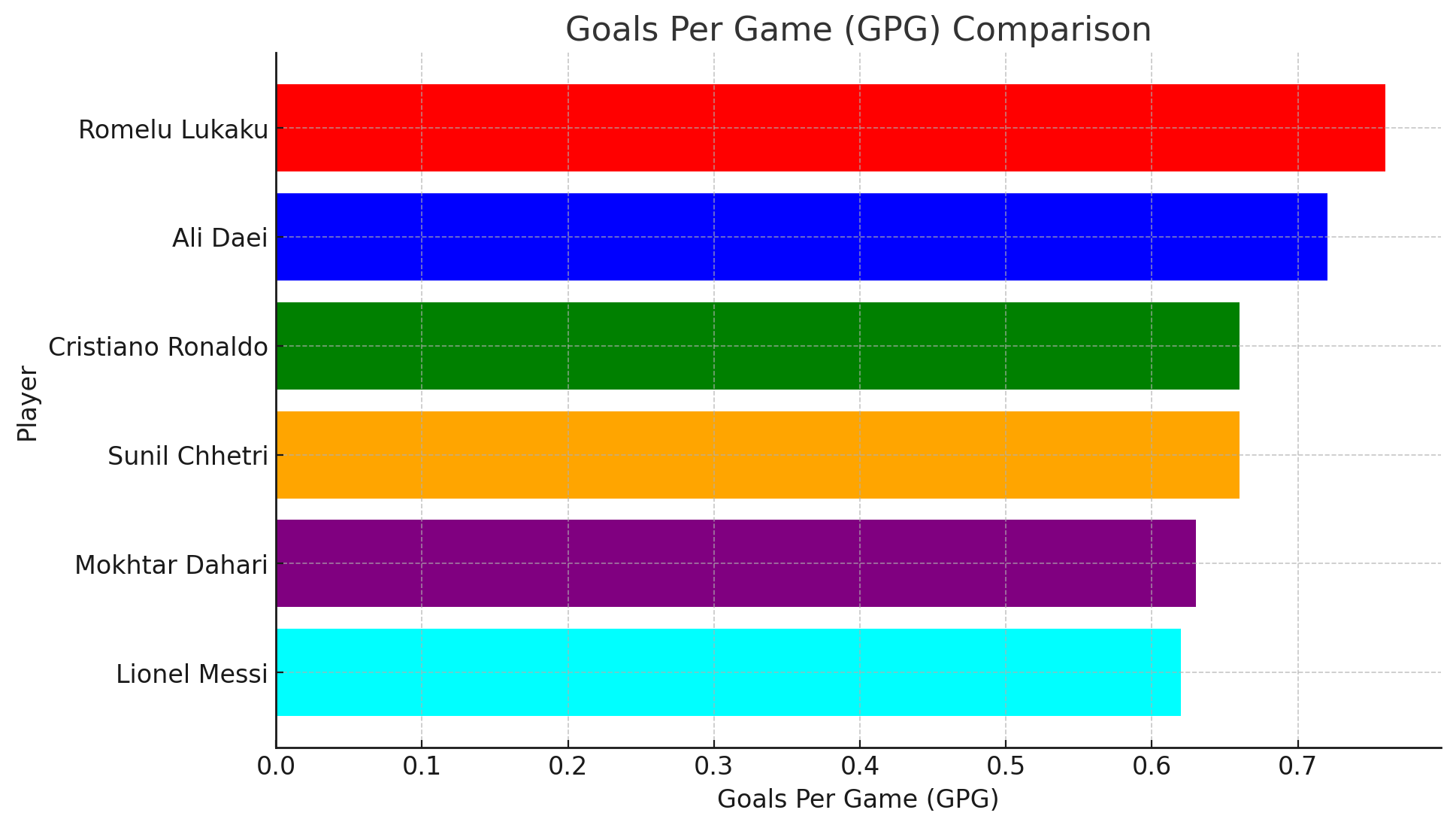
Here is what the Chart looks like based on the above numbers:
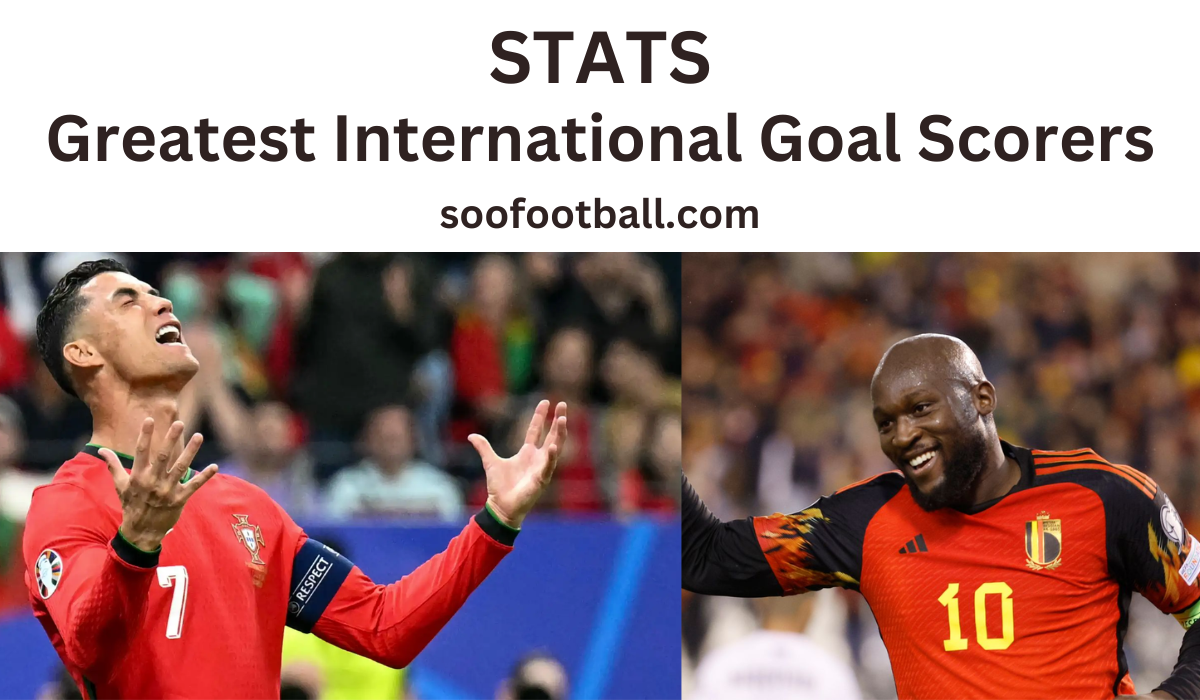
The numbers reveal some fascinating insights. Despite being the highest scorer, Ronaldo’s GPG ratio of 0.66 is lower than that of Ali Daei (0.72) and Belgium’s Romelu Lukaku, who leads the pack with 0.76 goals per game.
Lukaku’s numbers are remarkable. The Belgian striker has been a consistent goal threat for his country, averaging more than three goals every four games. His GPG is 15% higher than Ronaldo’s and significantly better than Lionel Messi’s 0.62 GPG, making him the most efficient goal scorer among the top six.
How Close is Lukaku to the Top 3?
Lukaku may be in sixth place now, but with 86 goals at just 30 years old, he has time on his side. The Belgian goal machine needs 22 more goals to surpass Ali Daei and enter the top three.
Based on his scoring average of 0.76 GPG, he would likely need around 29-30 more matches to achieve this feat. Considering Belgium’s regular international schedule—including European qualifiers and Nations League matches—Lukaku could realistically break into the top three within the next two to three years.
Who Has the Best Longevity?
Longevity plays a crucial role in accumulating international goals. A player with a longer career at the top level has more opportunities to score. Cristiano Ronaldo leads in this aspect, with a staggering 205 caps, proving his ability to maintain elite-level performance for over two decades.
Messi (180 caps) and Chhetri (143 caps) also demonstrate remarkable longevity, but Iran’s Ali Daei had one of the shortest careers among these legends, needing just 149 appearances to score 108 goals—a testament to his clinical finishing.
Comparing Their Peaks – Who Had the Best Goalscoring Period?
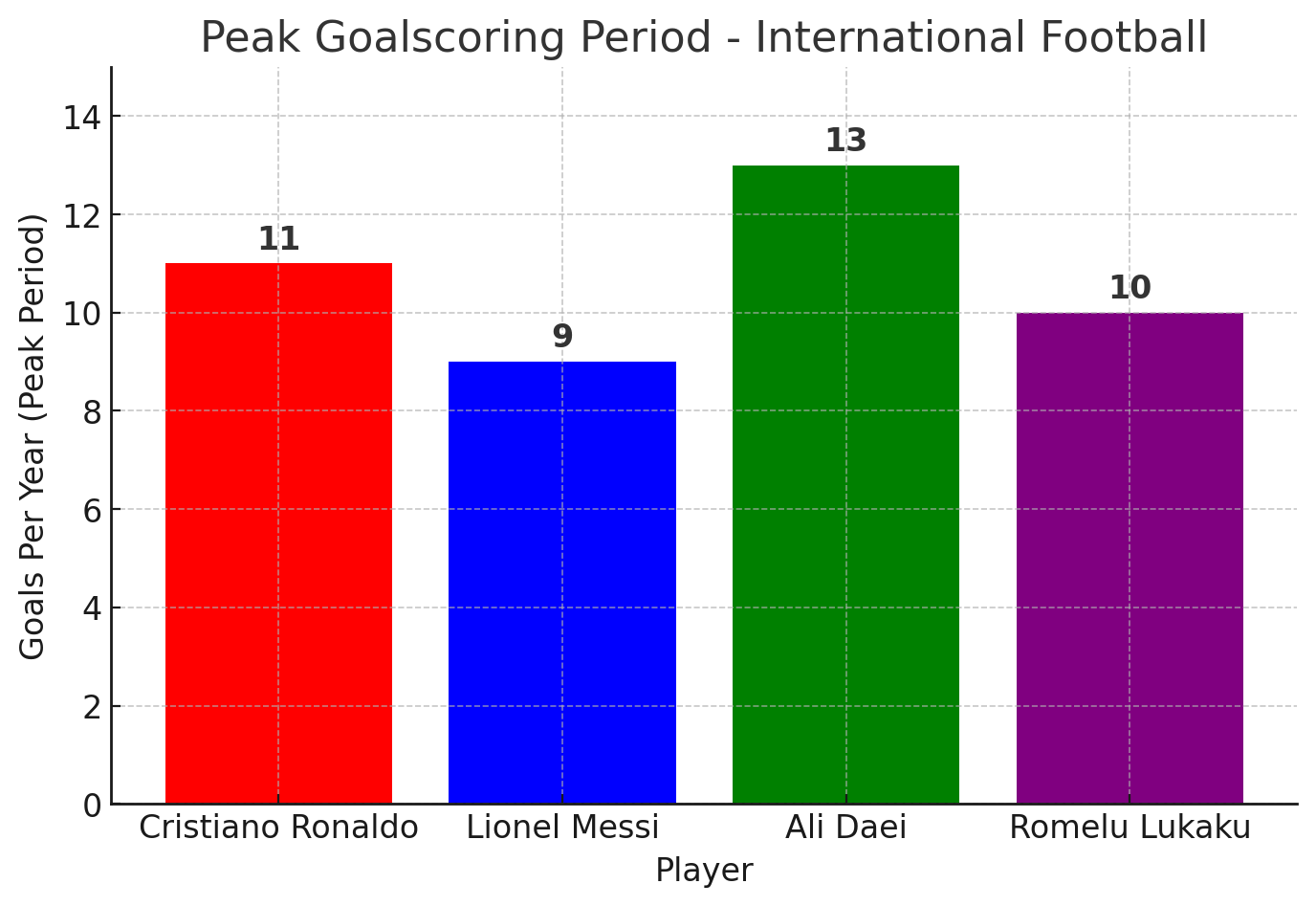
To further analyze their impact, we can look at how many goals they scored per year at their peak:
Cristiano Ronaldo (2016-2022): Averaged 11 goals per year for Portugal.
Lionel Messi (2017-2023): Averaged 9 goals per year for Argentina.
Ali Daei (1996-2004): Averaged 13 goals per year for Iran.
Romelu Lukaku (2018-2023): Averaged 10 goals per year for Belgium.
Ali Daei’s dominance in the late 90s and early 2000s stands out, proving why he was the record-holder for nearly two decades before Ronaldo broke it. Meanwhile, Lukaku’s current trajectory suggests he could maintain a similar level of output over the next few years.
Final Thoughts – Who is the Greatest International Goal Scorer?
The debate over the best or greatest international goal scorers isn’t just about numbers—it’s about efficiency, consistency, and longevity.
Cristiano Ronaldo is undoubtedly the most prolific, with the highest total goals and the longest career at the top. However, Romelu Lukaku is the most efficient, with a GPG of 0.76 in just 113 appearances.
Romelu Lukaku could be the next big name to break into the top three if he maintains his scoring form.
With international football constantly improving, it will be exciting to see how these rankings change in the next few years.
Who do you think will finish as the greatest international goal scorer? Drop your thoughts in the comments below!
The UEFA Champions League represents the pinnacle of European football, and for Bundesliga teams, qualifying for this prestigious competition is a significant achievement. Competing against Europe’s best clubs, Bundesliga sides not only get the chance to display their talent on the international stage but also gain access to substantial financial rewards and the opportunity to attract global attention. The allure of competing in the Champions League is undoubtedly one of the driving forces for clubs in Germany’s top football division, offering a platform for growth and success.
In terms of qualification, the number of Bundesliga teams that can enter the Champions League each season depends on several factors. Typically, the top four teams from the Bundesliga earn direct spots in the group stages of the Champions League. This structure remains relatively consistent, although recent changes in European football competitions have led to the possibility of extra spots based on the league’s performance in European tournaments. It is important to note that the top teams not only benefit from their domestic achievements but also their standing in UEFA’s country coefficient rankings, which influence how many spots each league can offer.
For Bundesliga teams, securing a spot in the Champions League is an important goal. The qualification process takes into account various factors such as league position, UEFA coefficients, and the potential for a fifth spot through special circumstances. Understanding the qualification process and the factors that influence the number of spots available for Bundesliga teams is essential for fans and clubs aiming for success in European football.
In this article, we will explore how many Bundesliga teams qualify for Champions League, the factors that influence this process, and the exciting possibilities for the future.
Standard Qualification Criteria for Bundesliga Teams
To understand how Bundesliga teams secure their spots in the UEFA Champions League, it’s important to first examine the standard qualification criteria. In general, the top positions in the Bundesliga determine which teams will represent Germany in Europe’s most prestigious competition. The league’s performance throughout the season directly affects the number of available spots, and the qualification process is designed to reward the best teams based on their domestic success.
At the heart of this process are the top four positions in the Bundesliga standings. The first four teams at the end of the season are typically awarded automatic spots in the group stage of the Champions League. This system has been in place for several years, and it reflects the competition’s emphasis on rewarding the highest-performing teams from each country. However, there are additional factors, such as UEFA’s country coefficient rankings, which can influence the exact number of teams a league can send to the tournament.
One important aspect to consider is the role of the UEFA coefficients in this process. Each national league is assigned a coefficient score based on its clubs’ performances in European competitions over a ten-year period. The higher the coefficient, the more spots the league earns. For example, the stronger performances of Bundesliga clubs in the Champions League and Europa League in recent years have helped Germany maintain its strong position in UEFA rankings. As a result, the Bundesliga can often secure four Champions League spots without issue.
The top four teams in the Bundesliga standings automatically qualify.
UEFA country coefficients impact the number of spots allocated to each league.
Special circumstances can provide additional spots, such as strong performances in other UEFA tournaments.
Clubs must meet the UEFA licensing requirements to participate in European competitions.
In addition to the top four spots, the fifth spot for a Bundesliga team can be achieved through a few exceptional circumstances, such as a strong performance by German clubs in European competitions or changes in UEFA’s rules. While the fifth spot has not been consistently available in every season, it remains a possibility for the future, depending on Germany’s overall standing in UEFA’s rankings.
While the general qualification process is relatively straightforward, it’s essential to understand how each factor contributes to the final outcome. The combination of strong league performance and historical success in European competitions allows Bundesliga teams to secure their places in the Champions League with relative consistency.
The Impact of UEFA Coefficients on Bundesliga’s Champions League Spots
UEFA coefficients are essential for determining how many teams from each country, including the Bundesliga, can qualify for the prestigious UEFA Champions League. These coefficients are based on the performance of clubs in European competitions over a ten-year period, which means that consistent success in Europe directly influences the number of spots a league is granted. The higher the coefficient, the more qualifying places the league earns in the tournament.
For the Bundesliga, the impact of UEFA coefficients has been significant. Strong performances by top clubs such as Bayern Munich, Borussia Dortmund, and RB Leipzig in the Champions League and Europa League over the years have boosted Germany’s coefficient. This consistent success has allowed the Bundesliga to maintain a position that typically guarantees four Champions League spots. The number of spots awarded to each country is directly influenced by these rankings, making the coefficient system a crucial element for German clubs looking to secure a spot in Europe’s most prestigious competition.
The Role of UEFA Coefficients
UEFA coefficients are calculated based on the performance of clubs in European competitions. For every win, draw, and overall success in these tournaments, points are earned for the league, which contribute to the overall coefficient. The higher the accumulated points over time, the more spots a league is allotted in the Champions League. For example, the Bundesliga’s historical success in both the Champions League and Europa League has played a pivotal role in securing its four Champions League spots.
Understanding the importance of UEFA coefficients is vital when considering how many Bundesliga teams qualify for the Champions League. The stronger the league’s performance in international competitions, the greater the chance of securing additional spots or maintaining the current allocation.
Case Study: Bundesliga Securing an Extra Champions League Spot
In certain seasons, the Bundesliga has been fortunate enough to secure an additional Champions League spot due to strong performances by its clubs in European competitions. This occurs when the league’s coefficient ranking increases, either because of consistently strong results in the Champions League or other European tournaments like the Europa League. As a result, UEFA may allocate an extra spot to the league, giving it the opportunity to send five teams to the Champions League.
A notable example of this occurred in the 2020-2021 season, when the Bundesliga was awarded an additional spot in the Champions League due to the consistent performance of German clubs in European competitions over the previous years. The success of teams like Bayern Munich and Borussia Dortmund in the Champions League and the strong performances of other clubs in the Europa League contributed significantly to Germany’s high UEFA coefficient.
This case study will demonstrate the season when the Bundesliga earned the extra Champions League spot and explain how the league’s performance in European competitions played a crucial role. By understanding the factors that contributed to this achievement, fans and experts can better appreciate the dynamics of UEFA’s decision-making process regarding league allocations.
Strong UEFA coefficient ranking and consistent European performance by Bundesliga clubs
The table highlights the five teams that qualified for the Champions League in the 2020-2021 season. The primary reason for this additional spot was the impressive performances of German teams in previous European competitions, which had a direct impact on the Bundesliga’s coefficient.
This example underscores the importance of a league’s consistent performance in international football and how it can impact the number of spots available for its clubs. The ability of Bundesliga teams to perform well in Europe not only raises the profile of the league but also ensures that German clubs continue to have multiple opportunities to compete at the highest level in European football.
Potential for a Fifth Bundesliga Team in the Champions League
The potential for a fifth Bundesliga team qualifying for the UEFA Champions League is an exciting prospect that depends on several factors, including Germany’s performance in European competitions and its position in UEFA’s coefficient rankings. Typically, the top four teams in the Bundesliga earn automatic spots in the Champions League, but there are certain conditions where the league could secure an additional spot. This possibility hinges largely on the overall success of German clubs in international tournaments like the Champions League and the Europa League.
One of the key ways for the Bundesliga to secure a fifth spot is through continued strong performances by its teams in European competitions. As Germany’s clubs such as Bayern Munich and Borussia Dortmund consistently perform well, they help boost the country’s UEFA coefficient, which could increase the number of Champions League spots for the league. With a higher coefficient, Bundesliga teams might have a chance to send a fifth club to the Champions League, giving more teams the opportunity to compete at the highest level in Europe.
The Role of the UEFA Coefficient in Securing Additional Spots
The UEFA coefficient plays a crucial role in determining how many teams each league can send to the Champions League. If the Bundesliga continues to perform well and maintain a high position in the UEFA rankings, it could potentially secure a fifth spot for one of its teams in the competition. Strong performances by German teams not only improve the league’s coefficient but also help increase the chances of additional spots becoming available.
While this extra spot is not yet a guarantee, the possibility remains open as long as the Bundesliga maintains strong performances in Europe. If this trend continues, it’s possible that how many Bundesliga teams qualify for Champions League could increase to five, providing more opportunities for German clubs to showcase their talent on the European stage.
The Challenges and Opportunities for Bundesliga Teams in the Champions League
Competing in the UEFA Champions League presents both significant challenges and unique opportunities for Bundesliga teams. As one of Europe’s most prestigious football competitions, the Champions League is an arena where the best teams from across the continent come together to fight for supremacy. For German clubs, the challenge lies not only in competing against Europe’s elite but also in maintaining consistent domestic performance while juggling the demands of European competition.
One of the biggest challenges for Bundesliga teams is balancing the intense domestic schedule with the rigorous demands of the Champions League. German clubs must be at their best in both competitions, which can be difficult with injuries, fixture congestion, and the physical toll of playing at such a high level. Additionally, the financial disparity between the Bundesliga and leagues like the English Premier League or La Liga often means that German teams have smaller budgets and fewer resources to invest in top-tier talent.
Challenge: Maintaining a balance between domestic league performance and Champions League demands.
Challenge: Competing against wealthier teams from leagues with larger budgets.
Opportunity: Increased global exposure and reputation through strong performances in the Champions League.
Opportunity: Financial rewards from deep runs in the competition, including prize money and sponsorship deals.
However, despite these challenges, there are numerous opportunities for Bundesliga teams in the Champions League. One of the main advantages is the exposure and recognition that comes with competing on the European stage. Performing well in the Champions League can elevate a team’s global reputation, attract better sponsorship deals, and help recruit top-quality players. Clubs like Bayern Munich have demonstrated how successful campaigns in Europe can lead to increased revenue, further investment in the team, and a more competitive domestic performance.
While the road to success in the Champions League is not without its obstacles, the potential rewards for Bundesliga teams are considerable. By maintaining a focus on both domestic and international success, these clubs can continue to thrive in Europe’s premier competition and enhance their standing in global football.
The Future of Bundesliga Teams in the Champions League
The future of Bundesliga teams in the UEFA Champions League looks promising, with continued success and growth both domestically and in European competitions. As the league continues to strengthen its position in UEFA’s rankings, there is potential for German clubs to secure additional spots in the prestigious tournament. The consistent performance of top teams like Bayern Munich, Borussia Dortmund, and RB Leipzig ensures that the Bundesliga will remain a strong contender in Europe.
While the qualification process remains competitive, the opportunity for a fifth Bundesliga team to qualify for the Champions League could become a reality if Germany maintains its high UEFA coefficient ranking. Strong performances from clubs across the league can continue to boost the country’s standing, providing more chances for clubs to participate in Europe’s elite competition.
In conclusion, understanding how many Bundesliga teams qualify for Champions League and the factors that influence this process highlights the complexity of the competition and the factors that contribute to Germany’s success in European football. The Bundesliga is on a solid path toward greater international recognition, and the future looks bright for German teams competing on the Champions League stage.